Reach the Right Point: Why Working Coverage Matters in Fixed Rock Breaker Boom Systems
In a crushing plant, space is rarely unlimited. Crushers, feeders, conveyors, steel structures, platforms, and access routes must all fit within a carefully arranged production area.
Installing a fixed rock breaker boom in this environment requires more than choosing a machine with sufficient power. The equipment must reach the required working positions, move within the available space, and operate without interfering with surrounding structures.
This is why working coverage is one of the most important considerations when selecting a fixed rock breaker boom system.
A properly designed boom arrangement helps ensure that the breaker can access the areas where oversize material needs attention while fitting naturally into the existing crushing station.
1. Reach Is Not Just a Specification on a Datasheet
When comparing rock breaker boom systems, working radius is often one of the first specifications considered. However, a single reach figure cannot fully describe how effectively a boom will operate in a particular installation.
The actual working area depends on several factors:
Boom length and arm configuration
Mounting height and installation position
Horizontal and vertical movement range
Breaker dimensions and orientation
Surrounding equipment and structural obstacles
Two systems with similar nominal reach may perform differently when installed in different environments.
For this reason, equipment selection should be based on the required working envelope rather than reach specifications alone.
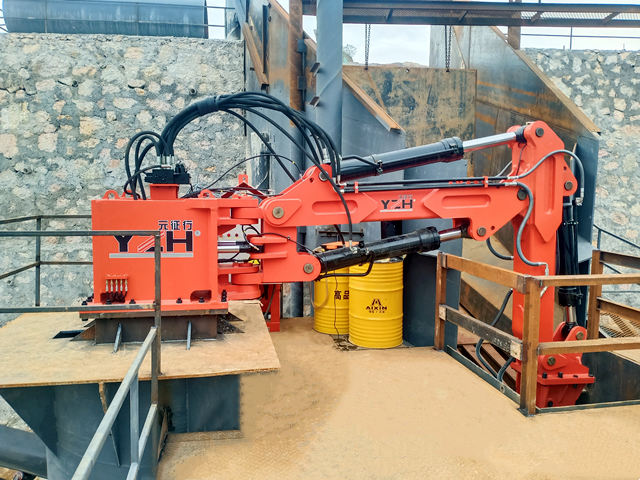
2. Every Crushing Station Has Its Own Geometry
A primary crusher installation may have a different spatial arrangement from a grizzly feeder or an underground crushing station.
Some installations provide sufficient room for a conventional boom arrangement. Others have limited clearance because of nearby columns, platforms, conveyors, or existing machinery.
These differences influence the position and configuration of the equipment.
During project evaluation, engineers should identify the critical working areas and determine how the boom can access them. The installation location should also account for structural support, equipment movement, maintenance access, and operator visibility.
Understanding the physical layout at an early stage can help avoid unnecessary design changes later.
3. The Working Envelope Must Match the Actual Breaking Area
The working envelope describes the area that the boom and breaker can access through their designed movements.
For a crusher application, this area may include different sections of the feed opening. At a grizzly station, the breaker may need to access multiple positions across the screening surface.
A suitable working envelope should provide sufficient coverage of the intended breaking area without requiring excessive boom extension or awkward positioning.
It is also important to consider whether the breaker can approach the target material at an appropriate angle.
A system that reaches the general area but cannot position the breaker effectively may not provide the required operational flexibility.
4. Avoiding Interference with Surrounding Equipment
Space conflicts are among the practical challenges of industrial equipment installation.
A boom must move through its intended operating range while taking into account nearby structures and machinery. Potential interference may involve:
Crusher housings and feed structures
Conveyor frames and transfer chutes
Steel columns and support beams
Maintenance platforms and walkways
Electrical installations and hydraulic lines
These elements should be considered during layout planning.
The objective is to provide sufficient movement clearance while maintaining safe access for inspection and maintenance.
A carefully planned arrangement can make the difference between equipment that merely fits into a plant and equipment that functions effectively within it.
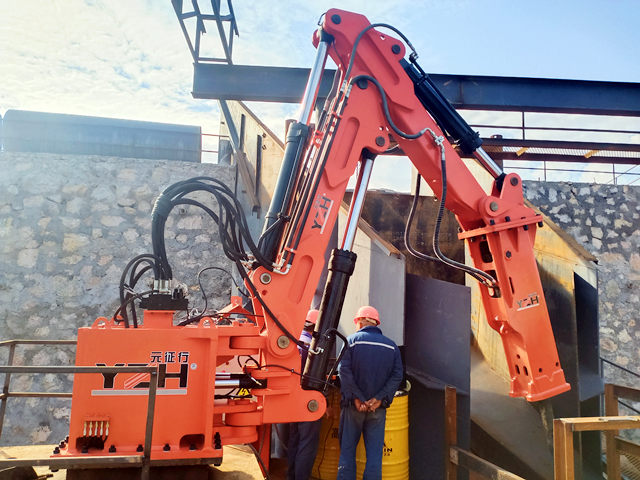
5. Mounting Position Influences the Entire Arrangement
The mounting position is closely connected to the boom's working coverage.
An installation point that is too far from the target area may require a longer boom configuration. A position that is too close may restrict movement or create interference with nearby equipment.
The supporting structure must also be suitable for the loads associated with the boom's operation.
Depending on the project, installation arrangements may involve concrete foundations, reinforced steel structures, or other engineered mounting solutions.
The final design should be evaluated according to structural conditions, operating loads, available space, and site-specific engineering requirements.
6. Design for Maintenance, Not Only Operation
A good equipment layout should consider what happens after the system enters service.
Hydraulic hoses, cylinders, pins, breaker components, and other serviceable parts may require regular inspection or maintenance. If the equipment is installed in a position that makes these components difficult to access, routine service work can become more complicated.
Maintenance access should therefore be considered alongside working coverage.
A practical installation should provide appropriate space for inspection, servicing, and replacement of relevant components in accordance with site procedures and manufacturer recommendations.
7. From Site Dimensions to a Suitable Boom Configuration
Selecting a suitable system begins with understanding the application.
Before determining the equipment configuration, project teams should consider:
The dimensions and layout of the working station
The location and size of the areas requiring breaking
Required horizontal and vertical reach
Mounting height and structural conditions
Potential interference with existing equipment
Maintenance access and operating requirements
Accurate site information, photographs, layout drawings, and relevant dimensions can help support the engineering evaluation.
This information provides a practical foundation for determining the boom arrangement and breaker configuration required for the project.
The Best Reach Is the Reach That Works on Site
A fixed rock breaker boom system should be designed around the working environment in which it will operate.
Reach, movement range, mounting position, structural support, and surrounding equipment all influence the effectiveness of the final installation.
Rather than selecting equipment based on a single specification, plant owners and engineers should evaluate how the complete system will fit into the actual crushing station.
At YZH, we focus on fixed rock breaker boom systems for mining, quarrying, and heavy-duty industrial applications. Equipment configurations can be considered according to project dimensions, required working coverage, installation conditions, and operational needs.